

Marketing is a key part of running a business, and it is important that all activities are well-coordinated to ensure success and that the company reaches its target audience.
Customer needs
When selling a product or service, there are two important factors that must be in place: company success and meeting the needs and desires of customers. To succeed in both, the market the company intends to enter must be defined.
It is important to understand what the customer wants and needs in order to meet their expectations of the company's operations. An analysis of the market, competition, and the prospective target audience must be conducted. Goals must be set and a plan must be developed to achieve the intended objectives. Below are the main factors that must be considered in marketing.
Marketing plan
To create marketing and sales plans that are more likely to succeed than others, numerous tools and resources are available to explore market receptiveness. The key is for sales and marketing to work together to increase value for both the customer and the company. A well-crafted marketing plan increases the chances of success.
It is good to examine the size of the market (number of customers / sales volume) and its characteristics, such as seasonal fluctuations. You also need to carefully review the trends that have occurred in recent periods. It should be checked whether customer buying behavior has changed or if any external factors in the economic or political environment are likely to affect the market in the future.
Surveys can be conducted both informally and formally.
Marketing plans should cover all marketing activities, whether they are in traditional or online media, and whether you use content marketing strategies or traditional advertising. In a marketing plan, you also make arrangements for the sales channel.
Market analysis
One key element of a market-oriented company is to base marketing plans on information from the market. For information gathering to be focused, the subject matter must be well-defined and specific. Information gathering can take various forms. Reviewing existing data, such as sales figures, market trends, and various economic indicators, can be effective. Information can also be gathered by posing questions to a specific target group or conducting a formal market research. Information gathering can also involve examining market size, prices, and trends; customer opinions on a product's features; potential distribution channels; market purchasing behavior; and an analysis of competitors. It can also be important to research laws and regulations. The analysis can be divided into four components: market conditions, the internal and external environment, competition, and target audiences.
What are the current market conditions for this product/service? Market size (number of customers, sales volume) and market characteristics (e.g., seasonal fluctuations in demand). What is the likely market development? Is it growing? Have any recent changes occurred, for example regarding purchasing behavior, product development, or innovations?.
Examine the size of the total market for your product or service, and then calculate how much of a share you can acquire in order to determine the scope of sales. You need to take into account growth and development of the market here. Also, you should consider where you plan to sell the product, i.e., calculate how large the market area is. This will help you better determine if its size is in line with your goals. Then, don't forget about the competition. Is the market so saturated that your calculated market share won't align with your sales forecast?
Demand for products varies by season, region, country, competition, city, laws, regulations, etc. For example, ski resorts sell the most during the winter months, while hostels sell the most during the summer months.
Markets are constantly changing. They grow, they shrink, and they evolve. It is essential to examine whether a market you intend to target has grown or shrunk year-over-year and then analyze the reasons behind those changes. People change their use of products and services based on trends and fads, but changes in a product or service's target audience can also be expected based on demographic information such as age, gender, income, education, occupation, etc. Also based on personality traits such as desires, habits, values, attitudes, lifestyle, behavior, opinions, etc. (see business in a box marketing plan)
Trends and the influence of fashion phenomena and influencers on the prevailing trends at any given time can have a decisive impact on small businesses. In an informed society, it is even more important to stay on your toes and keep up with the rapid changes that occur in communities and the world.
It is necessary to examine whether any factors in the economic or political environment are likely to affect the market in the near future. One of the methods for this examination is SWOT analysis. With SWOT The analysis examines the company's (S) strengths and (W) weaknesses, as well as what (T) threats could potentially affect the company and what (O) opportunities might exist in the market. PESTEL is also used to further examine external environmental factors such as political, economic, technological, environmental, and legal.
Trends and the influence of fashion phenomena and influencers on the prevailing trends at any given time can have a decisive impact on small businesses. In an informed society, it is even more important to stay on your toes and keep up with the rapid changes that occur in communities and the world.
Competitive analysis
It is necessary to determine the level of competition in the relevant field, its characteristics, and whether the competition is international, domestic, or regional. It is necessary to understand competitors' actions and build your own unique position based on this information. With such practices, the company is better equipped to gain a competitive advantage in the market. Tools and techniques can be used to better understand and ensure that all the most important aspects are thoroughly examined. Porter's Five Forces model is a tool that is simple to use. SWOT and PESTEL are also widely used.
It should be kept in mind that competition can take various forms and can be direct or indirect. A different type of product could possibly substitute for the product/service in question. For example, movie theaters could be considered to be in indirect competition with bowling alleys in the entertainment category.
Business collaboration can be extremely valuable, whether within or between different industries. Through such collaboration, companies can often open up new opportunities and create new value. For example, collaboration between companies in the technology and fisheries sectors has often created new opportunities and value.
It is important to divide potential customers into target groups to save energy, capital, and time. This is called market segmentation, and it can be based on different factors, for example:
- Geographical distribution (of a quarter of the country, a city district, or other areas)
- Demographic distribution (age, income, education)
- Individual characteristics (lifestyle, personality)
- Shopping habits (magnitude, security, reason)
What are the characteristics of each group and how can it be reached. Who are the prospective customers (your segmentation, target group), who to sell the product to (note: there can be different groups for the company's different products) What are the characteristics of the selected target groups (age, income, education, lifestyle, personality, values, etc.) Consider which unique characteristics of each target group can be used as indicators of how to reach that group (e.g., what media do they use, what are their purchasing habits, etc.). Where do the customers live? What are the purchasing habits of the main customers, and how will the company accommodate them?
What will be the company's primary target market for the time being? A specific region of the country, the entire country, a specific country abroad, or a single city abroad? The more clearly the target market is defined, the more successful you will be in reaching potential customers.
It is important to set specific marketing goals, and the goals should be SMART – specific, measurable, achievable, realistic, and time-bound. The goals should focus on growth in some form, in sales, market share, return on investment, etc. For a specific period, geographical area, or sales territory.
Example:
- To increase sales of product X by Y% in the year 20XX by creating a Facebook marketing campaign.
- Increase brand awareness among target group X for Y% in 20XX
- Get 30 new customers from target group X in the first/second/third/fourth quarter
- Sell 100 products a week
- Increase market share by 5% this year
- Reduce marketing costs by 10% over the next 6 months
Goals can be divided into two types: short-term goals (1 year) or long-term goals (3–5 years).
Marketing strategy
Once a company has defined which market to target and set its objectives, it must decide how to conduct its marketing to achieve those objectives. To achieve the greatest possible overview, the four Ps are often used: product strategy, pricing strategy, distribution strategy, and advertising and promotion strategy.
Product/Service
A strategy must be developed for the product, e.g., target audience, image, brand, etc., and sales performance goals must be set. The product may need to be adapted to best fit the needs of the target group, e.g., packaging, warranty, quality, etc.
Price
How is the product's price determined? Is it based on competitors' prices, the costs of production and/or handling, or what the customer is willing to pay? Will pricing vary by season? Should certain groups be offered special pricing? Payment terms: How will the product be paid for?
Distribution
How will the product be distributed to customers? Will the company sell directly to customers, through retailers (stores), or through other intermediaries? Is the product perhaps sold exclusively online? If the company plans to sell directly to customers, it is important to carefully consider the company's location and how it is convenient for customers.
The company's advertising and promotional policy
A promotional strategy must be developed for the product, and performance goals must be set. In this regard, consideration must be given to the best way to deliver information to the target audience. It must be decided which media will be used for this purpose, e.g., newspapers, television, magazines, or the Internet. What channels will be used to reach customers (advertising, direct mail, website, social media, direct one-on-one contact, etc.). When it comes to social media advertising, the main point is that it's more about adding value for the viewer than selling them something, so the content, its appearance, messaging, length, design, and placement need to be considered.
Social media is made for relevant content that is worth viewing, commenting on, and sharing with others. Therefore, it is important for companies to familiarize themselves with this environment. This article will cover some good tips for content production and examine the main social media platforms and their roles. Please note that this is not an exhaustive summary, but rather a quick way to get an overview.
Most business owners realize that using social media can be one of the most effective and fastest ways to get the attention of customers. It is important to realize that this is part of the company's overall marketing and must therefore be based on the same values as the company's other marketing activities.
Good to have straightened out before you get started:
Who is the target audience: Where is the target audience? What media does it use? What does it talk about? What catches its attention?
What are the goals for using social media: Why use social media? What do your customers gain by "liking" you on social media? How to measure and evaluate success?
What is the strategy: What topics? Who is responsible for what? Who is to respond and how? Is time set aside to monitor media developments?
What kind of media?
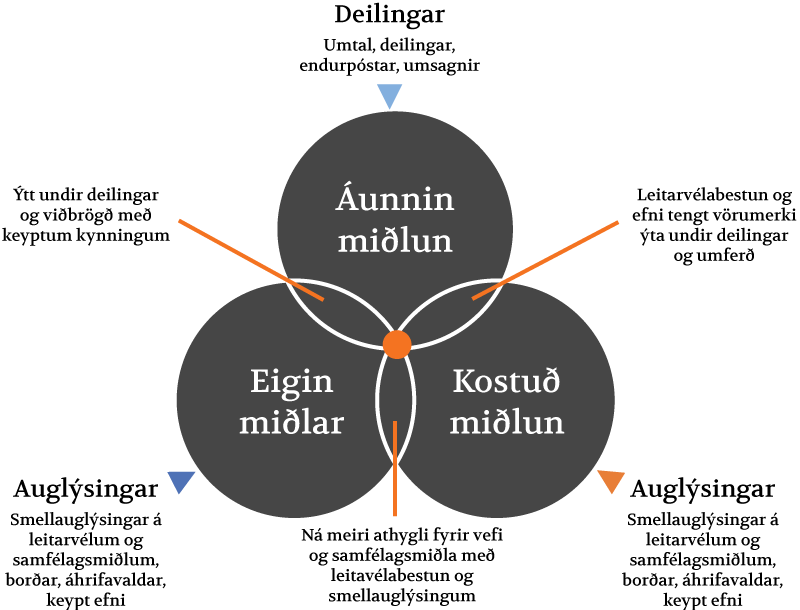
There are numerous ways to communicate to people what we want to offer them. However, they are of varying cost and time commitment. Through Costed mediation (television, radio, newspapers, web banners, text ads, influencers, etc.) and our Own channel (brochures, flyers, presentations, blog, a good website) we connect with customers, we build relationships.
Earned media It essentially refers to the reach we gain through loyal users, influencers, and collaborations with other brands that can help us promote our brand.
Content marketing applies to all media, and sometimes such marketing is even used unconsciously.
With good content, companies can inexpensively get themselves into coverage and achieve good distribution on social media. For example: a good story, an educational article, a value-driven blog post, beautiful coverage or a company achievement, a funny anecdote, a healing message, and so on. Content that matters and is of value to the customer.
But to reach the customer with the content we've produced for a specific target audience, we need to find the right platform to market ourselves and take the right path on that journey. But which social media platforms are suitable for the business?
Which social media platforms are suitable for the business?
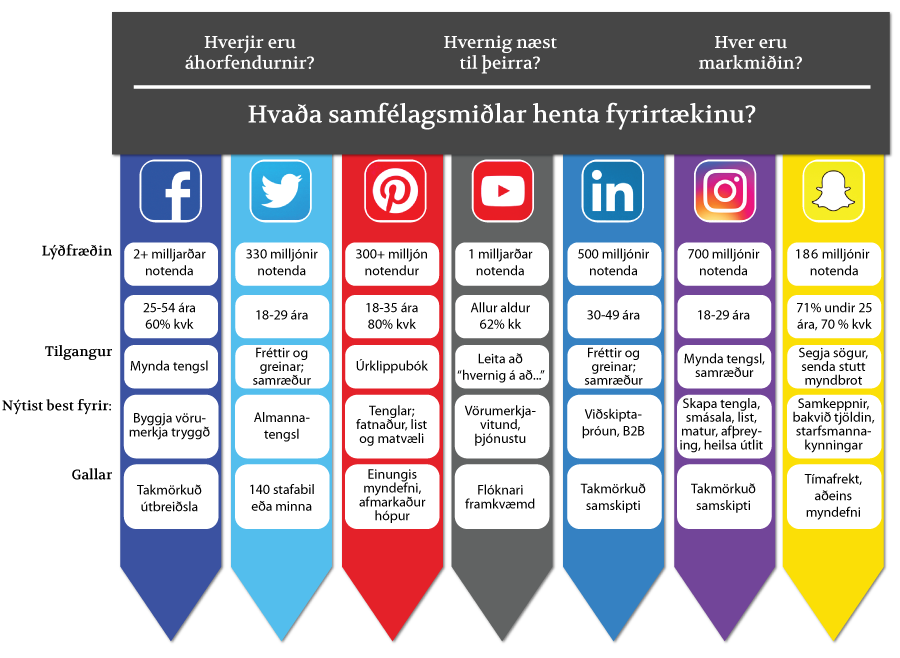
A large portion of Icelanders use social media daily. Over 20,000 Icelandic users use Twitter, and according to Facebook, 220,000 of their users are registered as residing in Iceland. People under 30 use social media for an average of 2-3 hours a day, and the competition for consumers' attention is immense.
Companies don't necessarily have to use all media to reach their target audience. Careful selection is required, especially for small businesses with limited time and funds to spend on these channels. Below is an overview of some of the main social media platforms, including their number of users, general age range, intended use, and the drawbacks of each.
It is a good idea to lay out the activities in a so-called publication plan, where, in an organized manner, a schedule is established for publishing promotional materials, advertisements, trade show participation, and anything else related to the company's visibility. A detailed publicity plan with timelines and a budget increases the chances of success in marketing.
Action and Sales Plan
It is necessary to have a good overview of all actions that need to be taken. These actions should be set up in a table that shows what, when, who, and how to carry out the actions.
Foreign market entry
In short, the following steps need to be taken before exporting begins: start with a market research, market analysis, and choose a way to enter the market. It is also a good idea to contact parties in the support environment such as European Center at the Innovation Center or The Icelandic Tourist Board to get advice.
When it comes to exporting, it is important to consider that markets are different, and therefore it is necessary to conduct a market research to understand how the new market and its customers work. There are numerous factors that can affect your ability to succeed in new markets.
The first thing that needs to be done when marketing products and services abroad is to conduct a market research that takes into account the laws and regulations that apply in the new market. In addition, it is necessary to take into consideration different cultures in the different markets when it comes to sales and marketing.
To be as well-prepared as possible for exporting to unknown markets, it is a good idea to familiarize yourself with the conditions there as thoroughly as possible. The first step in that process is to conduct a PESTLE analysis (Political; Economic; Social; Technological; Legal and Regulatory; Environmental). For this analytical work, there are numerous foreign sources that can provide good information.
- GAN Business Anti-Corruption Portal – A web portal with information on laws, regulations, and corruption http://www.business-anti-corruption.com/
- The World Trade Organization (WTO) – International Trade Organization; https://www.wto.org/
- Your Europe – Practical guide for doing business in Europe; http://europa.eu/youreurope/business/index_en.htm
- International Trade Center (ITC) – Support for the internationalization of small and medium-sized enterprises; http://www.intracen.org/
It is certainly possible to go directly to other markets with a product/service, but the sale of products and services in foreign markets very rarely happens without intermediaries. Companies need to examine the different distribution channels available and choose the one that best suits their product and/or service. It should also be noted that the types of intermediaries and the most suitable distribution channels vary from country to country, and this can also differ depending on the specific product and/or service. It is common to use an agent when starting to sell a product or service in a new market, as that person knows the market and the relevant industry well.
Some products are such that a company must have a presence in the market, and will likely need to establish a subsidiary or branch in the country where it plans to sell.
On the web The Icelandic Tourist Board You can find reliable information when it comes to choosing distribution channels abroad.